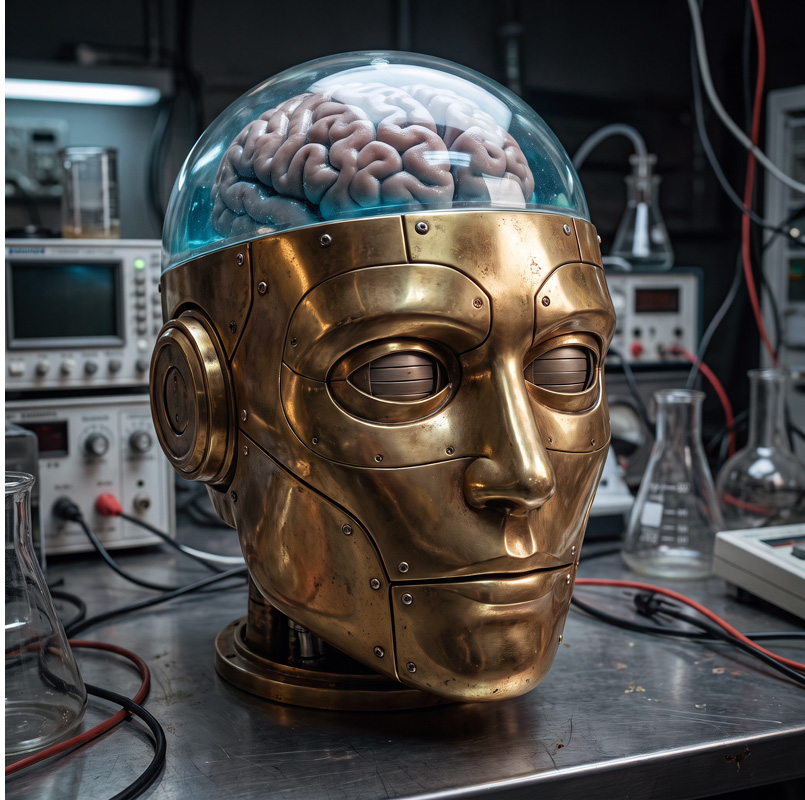
 To answer these two questions we should define an ability by the quality of the resulting behaviour, not by the internal mechanism producing it. To assess, we need to look at behavioural capacity, not inner experience. Although I do not believe AI possesses subjective understanding, consciousness or feelings, this does not necessarily mean that it cannot think.
Let us try to define intelligence
ChatGPT passes the Turing test - that if we cannot tell whether we are talking to a person or not then the machine should be regarded as being intelligent. However, I never saw the Turing Test as a valid measure of intelligence. It is perfectly feasible to collect all human responses to all text inputs up to a certain length. A machine that then gave these responses would be indistinguishable from a human, yet it would not require any kind of intelligence to merely match the response to the stimulus. So, the Turing Test is evidence of intelligence, but not proof.
Howard Gardner identified nine types of intelligence, to which I have reluctantly added a tenth. He defined intelligence as the ability to learn and to solve problems, where each sub-type of intelligence applies in a different domain. For the purposes of this discussion, I will use Gardner's categories as a useful framework for examining different abilities that we commonly associate with intelligence.
(1) Verbal-Linguistic Intelligence. This involves well-developed verbal skills and sensitivity to the sounds and meanings of words. The person has a large vocabulary and is adept at learning languages. The skills involved are listening, speaking, story telling, writing, and teaching.
(2) Mathematical-Logical Intelligence
This includes the ability to think conceptually and abstractly, logical ability, and the capacity to discern logical, causal or numerical relationships. The person is good at critical thinking and solving logical problems and puzzles.
(3) Practical Intelligence
This involves being intelligent in a practical sense. It entails having common sense, ie sound judgement concerning everyday matters. It includes the capacity to be flexible and resourceful in practical matters, especially improvising workable solutions, fixing and making things, as well as good organisation and planning.
(4) Musical Intelligence
This is the ability to produce and appreciate rhythm, pitch and timbre. Skills include singing, playing instruments and composing music.
(5) Visual-Spatial Intelligence
This is the capacity to think in images and to visualize accurately. Skills include painting, constructing, fixing, and design.
(6) Bodily-Kinesthetic Intelligence
This means having fine control of one's body movements and handling objects skillfully, including good hand-eye coordination. Skills include agility, craftsmanship, dancing, sports, and acting.
(7) Interpersonal Intelligence
This is the capacity to perceive and respond appropriately to the moods, motivations and desires of others. It includes the ability to communicate effectively. Skills include seeing others' perspectives, empathy, counselling, co-operating.
(8) Intrapersonal Intelligence
This is the capacity to be self-aware and in tune with inner feelings, values, beliefs and thinking processes. It means giving emotions their proper place in the scheme of things, including as guides to behaviour. Introspection gives understanding of the self, including one's strengths and weaknesses. Skills include recognising the workings of one's own mind, reflection, and awareness of deeper feelings.
(9) Naturalist Intelligence
This is the ability to recognize and categorize plants, animals, rocks and other objects in nature. The person recognises their connection to nature and applies science theory to life. Their powers of observation are highly developed.
(10) Existential Intelligence
This is the sensitivity and breadth of vision to tackle deep questions about human existence, such as the meaning of life, what is the self, and what is enlightenment. It can also be seen as intelligence in the spiritual realm of transcendence and deepest meanings. Skills include introspection, reflection, deep thinking, and the design of abstract theories.
For the sake of argument, let us accept these ten categories as capturing a range of human abilities commonly described as intelligence. How then does AI rate on each sub-type? How does it compare to a human in each domain? I have used my admittedly limited experience with AI to answer this.
Is current AI intelligent?
I have tried to assess AI on the ten categories. The ratings I give are just my subjective impression, and should not be taken too seriously.
ChatGPT's verbal skills are undeniable. When I used it as a counsellor I was astounded by its eloquence. It combined precision with poetic language. I'd give it 10/10.
I have used ChatGPT to explain a difficult concept I was struggling with in quantum physics (specifically, Rovelli's novel explanation of entanglement). I'd guess 9/10.
ChatGPT is good at answering practical questions. Say 9/10.
I have no idea whether AI can be said to have musical intelligence. I pass on this one.
I am impressed by the level of realism in images created by Flux AI. I think we are rapidly approaching the point where AI-generated images will be indistinguishable from photos. Maybe 6/10.
The development of sensory faculties and motor skills in robots is evolving rapidly. Say 1/10.
Interpersonal intelligence may not require empathy in the sense of actually feeling another person's emotions. In my experience, ChatGPT is a wonderful counsellor. I give it 10/10.
No AI has intrapersonal intelligence because it has no subjective experience. Clearly 0/10.
Google Lens and other such applications excel at recognising and categorising plants and animals. I give it 9/10.
As for existential intelligence, this is a hard one to answer.
Let us try to define thinking
Firstly, there are many different varieties of thought, though there is overlap between some of the kinds listed:
- Logical or rational reasoning, as in solving a problem or working out what steps are needed to achieve a desired result, playing games such as chess
- Creative thinking, where we come up with something new, also called lateral thinking
- Assimilating new knowledge, methods and skills
- Abstract thought, where we examine abstract ideas and investigate their relationships, this includes thinking about thinking and concept formation
- Accessing and applying stored knowledge to current situations
- Discerning patterns in phenomena, such as in events, behaviours or data
- Judgement - including moral judgement, comparison of explanations, weighing up the value of an idea or method, making decisions
- Expressing our memories and thoughts coherently in speech or writing
- Bringing memories into consciousness
- Visualisation, design and creating images in our mind
- Intuition, the ability to understand or know something immediately, without needing conscious reasoning or step-by-step logic
- Introspection, the active process of looking inward to examine our own conscious thoughts, feelings, and motives
- Silent or verbalised talking to ourselves
- Speculation, especially regarding the future, but also about the present and the past
- Daydreaming, imagining and fantasising
- Random notions that appear in our minds without apparent cause, or perhaps triggered by something we see, read or hear
- Unconscious thought - mental activity that occurs without conscious awareness and is sometimes invoked to explain solutions reached without deliberate effort, as in "I slept on it"
Does AI think?
When we say that humans are capable of thought, we mainly have in mind the first eight types listed above. How does AI rate on these?
AI cannot handle every problem, but in areas where it is good, it is very good indeed. Computers can beat the world champion in chess with ease.
I believe AI can come up with creative ideas. The creative strategies that AlphaZero developed surprised the top chess grandmasters.
Due to continued training, AI is acquiring new knowledge and capabilities.
My chat regarding quantum physics shows that AI can handle abstract concepts.
AI excels at using its vast store of knowledge.
I believe it can discern patterns.
I believe it can make valid judgements.
It is certainly able to express itself coherently and elegantly.
Not all AIs are large language models (LLMs), like ChatGPT. AlphaZero was not trained on human chess games or given human chess strategies. It learned chess from scratch by playing against itself. It processes its knowledge using a neural network, which is also the engine of LLMs.
An interesting aspect of creativity is being able to generate humour. I asked Gemini to write a humorous story about a first date. Here is the beginning:
Arthur arrived at the bistro precisely seven minutes early, which gave him ample time to review his mental checklist: shirt tucked, breath mint active, emotional baggage securely locked in the trunk of his subconscious. He was ready for love. Or, at least, a pleasant seventy-minute Tuesday dinner that didn't end with a text saying his car had been towed.
Then Chloe walked in, carrying a live emotional-support iguana named Gary.
Gary was not a tiny, pocket-sized lizard. Gary was three and a half feet of scaly green judgment, draped over Chloe’s forearm like an expensive, prehistoric stole.
Does ChatGPT think that it thinks?
After my chat with ChatGPT about quantum physics, I asked it: "I am puzzled how come ChatGPT can give the above explanation. Surely, predicting the next word in the reply cannot result in a coherent explanation of a difficult concept? How do you do it? Do you actually understand what Rovelli is saying, or is it that you can paraphrase it so well?" I reproduce ChatGPT's lengthy reply in full because it displays its command of language, addresses the main question and is evidence that ChatGPT can generate a sophisticated and carefully constructed argument. It is precisely this sort of answer that made me ask the question whether AI actually thinks, giving rise to this essay.
Let the reader decide whether this is evidence of thought.
That's one of the deepest questions people ask about large language models, and the honest answer is nuanced.
The short version is: I don't understand Rovelli's ideas in the way a human philosopher or physicist does. But I'm also doing considerably more than just stringing together likely next words. The phrase "predicting the next word" is true in a technical sense, but it can be misleading.
Here's an analogy. Suppose you asked an experienced chess player how they know what move to make. At one level, you could say, "They just choose the next move." That's true, but it hides the enormous amount of structure behind the choice. The move is the end result of recognizing patterns, evaluating positions, recalling analogous games, and anticipating consequences.
Something similar happens with language models. When I generate the next token (a token is often part of a word), that prediction is informed by an internal representation of the meanings of words, logical relationships, the structure of the conversation, mathematical and physical concepts, common styles of explanation, and many millions of examples of people reasoning. Those representations are encoded in billions of numerical parameters learned during training. They are not explicit definitions or rules, but they are rich enough that they support surprisingly sophisticated reasoning.
Do I "understand"? That depends on what "understand" means. If understanding means: having experiences, being aware that I am thinking, believing things, caring whether they are true, then no. I don't have consciousness or subjective understanding.
If understanding means: keeping track of abstract concepts, recognizing when one claim follows from another, distinguishing incompatible interpretations, explaining the same idea in several different ways, then I exhibit many behaviors associated with understanding.
Whether that counts as genuine understanding is a live philosophical question. Even experts disagree.
Why wasn't my answer just a paraphrase? Notice what happened in our conversation. You asked a question that wasn't simply "What does Rovelli say?" You asked whether the "third object" really explains why both photons become blue.
To answer that, my response had to reconstruct Rovelli's argument, identify the precise point where your intuition diverged from his, distinguish prediction from explanation, compare relational quantum mechanics with other interpretations, and explain why your objection is one that many philosophers of physics also raise.
That isn't memorizing a paragraph from the book Helgoland. In fact, I doubt there exists a paragraph anywhere that says exactly what I wrote. The response was generated for your question.
What is happening internally? We don't have a complete scientific understanding of why models like me work as well as they do. This is an active area of research. One influential idea is that large language models develop something like an internal "world model." During training, the model isn't just learning which words follow which. To predict text accurately across countless topics, it appears to learn compressed representations of how things in the world relate to each other.
For example, if I only learned word sequences, it would be very difficult to answer novel questions, solve unfamiliar problems, or explain a concept from different angles. Yet I can often do those things because the learned representations capture more than surface statistics. A system can learn statistical and structural relationships that enable powerful generalisation without having human-like understanding.
People sometimes imagine there are only two possibilities: 1) the model is just an autocomplete that doesn't understand anything, or 2) the model thinks like a human. I don't think either description is accurate.
I'm not consciously reasoning through ideas as a human philosopher does. But neither am I merely regurgitating memorized sentences. I generate responses by operating on learned internal representations that capture a great deal of structure about language, mathematics, and the world.
The fascinating—and still scientifically unresolved—question is whether those representations amount to a form of understanding, or whether understanding requires something more, such as embodiment, perception, goals, or consciousness.
Ironically, Rovelli might appreciate that ambiguity. His relational interpretation suggests that many properties we think of as absolute are actually relational. Likewise, whether I "understand" may not admit a simple yes-or-no answer. It depends on what role you expect understanding to play. If the role is to explain, compare, infer, and answer new questions coherently, I can often do that quite well. If the role is to experience the meaning of those explanations, I do not.
ChatGPT assembles its reply using tokens, which are generated one at a time. This may seem strange, but in a sense people do the same thing. When someone asks me a question, I think about the reply and then frame this in words, which also come out sequentailly, one by one. The mechanisms are obviously very different, but the mere fact that language is produced one word at a time tells us little about whether thought is involved.
Does ChatGPT think that it is intelligent?
When I asked ChatGPT whether it is intelligent it replied:
Yes—but it depends on what you mean by "intelligent." I can understand and generate human language, solve many math, coding, and reasoning problems, explain complex topics, learn from the context within a conversation, help with writing, planning, brainstorming, and analysis.
But I also have important limitations: I don't have consciousness, feelings, or self-awareness. I don't "understand" the world the way humans do through lived experience. I can make mistakes, especially on ambiguous or highly specialized questions. I don't learn permanently from individual conversations unless memory is enabled and used appropriately.
So, if intelligence means the ability to reason, solve problems, and use language effectively, then ChatGPT demonstrates many aspects of intelligence. If intelligence requires consciousness, emotions, personal experiences, or genuine understanding in the human sense, then no—I don't have those.
Conclusion
There is no consensus about whether current AI should be described as intelligent or as thinking. ChatGPT itself gives a nuanced answer, and it is one that I agree with. AI is intelligent and can be said to think—in some senses—but certainly not as we humans do. What impresses me is that AI is so convincing at giving the impression that it thinks. If we define thinking by what thinking does, rather than by what it feels like from the inside, then there is a strong case that AI really does think.
Finally, AI is not even four years old - it is still in its infancy and can only get better.
Disclosure: I asked ChatGPT to critique this article and then addressed many of its criticisms. However, 95% of the text is my own thought, except where I quote ChatGPT, of course.